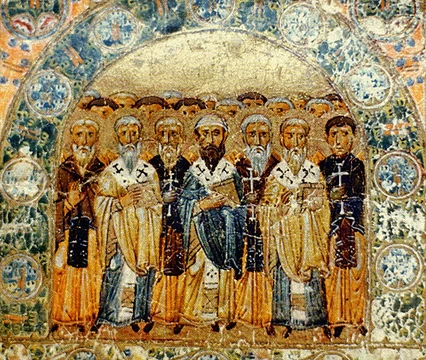
Maximus the Confessor
Monk and theologian who defended Christ's two wills.

Maximus the Confessor (c. 580 – 13 August 662), also known as Maximus the Theologian and Maximus of Constantinople, was a Christian monk, theologian, and Neoplatonic scholar. He is venerated in both the Catholic and Eastern Orthodox Churches, and his theological positions were upheld by the Third Council of Constantinople, leading to his recognition as a saint soon after his death. His title 'Confessor' indicates that he suffered for the Christian faith without being directly martyred.
- born
- c. 580
- died
- 13 August 662
- field
- Theology, monasticism, Neoplatonic philosophy
- nationality
- Byzantine (likely from Constantinople)
- known_for
- Dyothelite Christology, opposition to Monothelitism, theological synthesis of Neoplatonism and Christianity
Lore & Background
Very little is known about Maximus' early life, but scholars consider it likely he was born into an aristocratic family and received an exceptional education in philosophy, mathematics, and astronomy, possibly in Constantinople. He served as a civil servant and aide to Emperor Heraclius before leaving public life to become a monk at the monastery of Philippicus in Chrysopolis, where he later became abbot. After the Persian conquest of Anatolia, he fled to a monastery near Carthage, where he studied under Saint Sophronius and engaged deeply with the writings of Gregory of Nazianzus and Pseudo-Dionysius the Areopagite. Maximus became involved in the Monothelite controversy when a friend espoused that Christ had only one will. He supported the interpretation that Jesus had both a human and a divine will. He debated the deposed Patriarch Pyrrhus in Carthage, after which Pyrrhus admitted error. After a second trial in 662, his tongue and right hand were mutilated, and he was exiled to Lazica (modern-day Georgia), where he died on 13 August 662.
Reader's Guide
Maximus the Confessor's significance lies in his defense of dyothelitism—the doctrine that Christ possessed both a human and a divine will—against the Monothelite position, which held that Christ had only a divine will. His theological work preserved and interpreted Neoplatonic philosophy within a Christian framework, particularly through his study of Pseudo-Dionysius the Areopagite. He synthesized these ideas with Aristotelian logic, making them less liable to misinterpretation. His emphasis on theosis, or divinization, became central to Eastern Christian theology. He is venerated as a saint in both Catholic and Eastern Orthodox Churches and is considered one of the last Fathers of the Church recognized by both traditions.
Did You Know?
- Maximus was a civil servant and aide to Byzantine Emperor Heraclius before becoming a monk.
- He debated the deposed Patriarch Pyrrhus on Monothelitism, after which Pyrrhus admitted error.
- After his trial in 662, his tongue and right hand were mutilated to prevent him from speaking or writing.
- His theology was upheld by the Third Council of Constantinople, and he was venerated as a saint soon after his death.
More in Early Church Fathers And Saints 1-24
Elsewhere in the Early Church Fathers And Saints universe
Spotted an error? Know more?
This is a living reference — every entry is fact-audited, and reader corrections feed straight into our audit queue. Suggest an edit · See this site's audit record