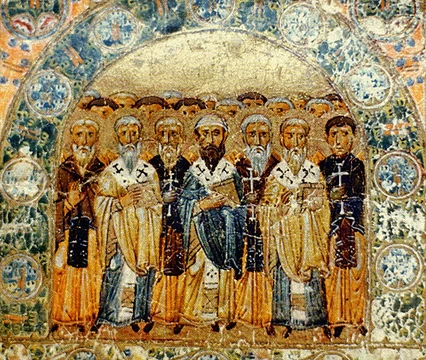
Basil of Caesarea
Early Christian bishop, theologian, and founder of the Basileias hospital.

Anonymous Unknown author · Public domain
He was an influential theologian who supported the Nicene Creed and opposed heresies such as Arianism and Apollinarianism. His most enduring legacy was the creation of the Basileias, believed to be one of the earliest forms of a Christian hospital for the poor, and he is remembered as a father of communal monasticism in Eastern Christianity.
- born
- c. 330, Caesarea Mazaca, Cappadocia
- died
- 1 or 2 January 379
- field
- Theology, monasticism, church administration
- nationality
- Cappadocian Greek
- known_for
- Support of the Nicene Creed, founding the Basileias hospital, establishing guidelines for communal monastic life
Lore & Background
Basil was born into a wealthy Cappadocian Greek family around 330. He was one of nine or ten children, and his parents were known for their piety. A common but unconfirmed tradition holds that his maternal grandfather was a Christian martyr, and his grandmother Macrina raised him and several siblings who are now venerated as saints. He received formal education in Caesarea Mazaca, Constantinople, and Athens, where he met Gregory of Nazianzus and the future emperor Julian the Apostate. After a period practicing law and teaching rhetoric, his life changed after encountering the bishop and ascetic Eustathius of Sebaste; he abandoned his career, was baptized, and traveled to study ascetics and monasticism.
Reader's Guide
Basil's significance lies in his theological defense of the Nicene Creed against Arianism and Apollinarianism, and his practical contributions to Christian charity and monasticism. As Bishop of Caesarea, he organized a soup kitchen during a famine and built the Basiliad, a large complex including a poorhouse, hospice, and hospital, which Gregory of Nazianzus compared to the wonders of the world. His writings on communal monastic life became pivotal for Eastern Christian monastic traditions. Together with his brother Gregory of Nyssa and friend Gregory of Nazianzus, he is known as a Cappadocian Father. He is recognized as a saint in both Eastern and Western Christianity, and as a Doctor of the Church in Roman Catholicism. His interaction with Emperor Valens helped define the limits of governmental power over the church.
Did You Know?
- A common but unconfirmed tradition holds that Basil's maternal grandfather was a Christian martyr executed before Constantine I's conversion.
- He and Gregory of Nazianzus collaborated on Origen's Philocalia, a collection of Origen's works.
- He is sometimes referred to by the epithet Ouranophantor, meaning 'revealer of heavenly mysteries.'
Theological Conviction and the Defense of Nicene Orthodoxy
Basil's theological career was defined by his fierce defense of the Nicene Creed against multiple heretical movements. While he initially leaned toward the Homoiousian faction—a semi-Arian group that held the Son was of like substance with the Father rather than the same substance—he ultimately broke from them after his bishop Dianius of Caesarea had subscribed only to the earlier Nicene formulation. This shift made him a powerful advocate for the orthodox position, and his skill in balancing deep theological conviction with political acumen gave him considerable influence in church affairs. Alongside Gregory of Nazianzus, Basil engaged in public rhetorical debates against accomplished Arian theologians, presided over by agents of the emperor Valens, and emerged victorious. These confrontations confirmed for both men that their calling lay in the administration of the Church. His opposition extended beyond Arianism to include Apollinarianism. Over time, Basil earned the title of Great Hierarch in the Eastern Orthodox and Eastern Catholic traditions, and was counted among the four Great Greek Church Fathers alongside Athanasius, Gregory of Nazianzus, and John Chrysostom. In the Roman Catholic Church, he is recognized as a Doctor of the Church.
Communal Monasticism and the Basileias
Perhaps Basil's most tangible and enduring contribution to Christian life was his reimagining of monastic practice. After a period of solitary asceticism near the Iris River, he concluded that the hermit's path did not suit his calling. Instead, by 358 he gathered a community of like-minded disciples—including his brother Peter—on his family's estate near Annesi, at the confluence of the Iris and Lycos rivers. His widowed mother Emmelia and sister Macrina joined the community, dedicating themselves to prayer and charitable works. Basil's written guidelines for this communal life emphasized three pillars: shared community living, liturgical prayer, and manual labor. Together with Pachomius, he is remembered as a father of communal monasticism in Eastern Christianity. Beyond the monastery walls, Basil founded the Basileias, widely regarded as one of the earliest forms of a Christian hospital serving the poor. This institution reflected his conviction that faith demanded practical care for the suffering, extending his monastic ideals of charity into the broader urban landscape of Caesarea.
A Wealthy Youth Transformed
Basil entered the world around 330 into one of Cappadocia's most prominent Greek families. His father, Basil the Elder, and mother, Emmelia, were noted for their deep piety, and his maternal grandfather had been martyred before Constantine's conversion. His paternal grandmother Macrina, a devoted follower of Gregory Thaumaturgus, raised Basil and four siblings who would all later be venerated as saints. Around 350, Basil pursued formal education in Caesarea Mazaca, then traveled to Constantinople to study under the renowned rhetorician Libanius. In Athens he formed a close friendship with Gregory of Nazianzus and encountered a fellow student who would become the emperor Julian the Apostate. For a time after returning to Caesarea, Basil practiced law and taught rhetoric. His life pivoted dramatically upon meeting Eustathius of Sebaste, a charismatic ascetic bishop. In a later letter, Basil described the moment as waking from a deep sleep, recognizing the emptiness of worldly wisdom. He abandoned his legal career, distributed his wealth among the poor, and devoted himself entirely to the spiritual life.
Ecclesiastical Trajectory and Enduring Recognition
Basil's path into formal church leadership was shaped as much by others' ambitions as by his own desires. In 362, Bishop Meletius of Antioch ordained him a deacon, and in 365, Eusebius of Caesarea summoned him to serve as presbyter, valuing his intellectual gifts as an assistant. The relationship soured, however, as Eusebius grew jealous of Basil's rapidly growing reputation and influence, eventually permitting him to return to solitude. Gregory of Nazianzus later persuaded him to re-engage. Basil ultimately served as Bishop of Caesarea Mazaca from 370 until his death on 1 or 2 January 379. His legacy transcended denominational boundaries: he is venerated as a saint in both Eastern and Western Christianity, honored as a Great Hierarch alongside Gregory of Nazianzus and John Chrysostom, and counted among the Cappadocian Fathers together with his brother Gregory of Nyssa and his friend Gregory of Nazianzus. The epithet Ouranophantor—meaning revealer of heavenly mysteries—captures the reverence in which his theological and spiritual insights continue to be held across multiple Christian traditions.
Gallery
Frequently Asked Questions
What is Basil of Caesarea best known for?
He is most remembered for championing the Nicene Creed against Arian and Apollinarian challenges, for drafting rules that shaped communal monastic life in the East, and for establishing the Basileias, regarded as one of the first Christian hospitals dedicated to the poor.
How does Basil of Caesarea's story end?
Basil passed away on either January 1 or 2, 379, in Caesarea Mazaca, where he had served as bishop for roughly nine years. His death came after a period of intense theological controversy and active pastoral work.
Why is Basil of Caesarea important to early church history?
He helped solidify Nicene orthodoxy during a turbulent era of doctrinal disputes and gave lasting structure to how Eastern Christians practiced communal monasticism. His hospital, the Basileias, also set a precedent for organized Christian charity toward the sick and destitute.
What is the Basileias and why does it matter?
The Basileias was a complex of buildings Basil founded in Caesarea to house and care for the poor, sick, and travelers. It is commonly cited as one of the earliest institutions functioning as a Christian hospital, marking a major step in organized charitable ministry.
More in Early Church Fathers And Saints 1-24
Elsewhere in the Early Church Fathers And Saints universe
Spotted an error? Know more?
This is a living reference — every entry is fact-audited, and reader corrections feed straight into our audit queue. Suggest an edit · See this site's audit record