Teresa of Ávila
Carmelite nun, mystic, and reformer of the Counter-Reformation.

Livioandronico2013 · CC BY-SA 4.0
Active during the Counter-Reformation, she became the central figure of a movement of spiritual and monastic renewal, reforming the Carmelite orders of both women and men, and later established the Discalced Carmelites with John of the Cross.
- field
- Mysticism, monastic reform
- nationality
- Spanish
- known_for
- Reforming the Carmelite orders, founding the Discalced Carmelites, writing The Interior Castle and The Way of Perfection
Lore & Background
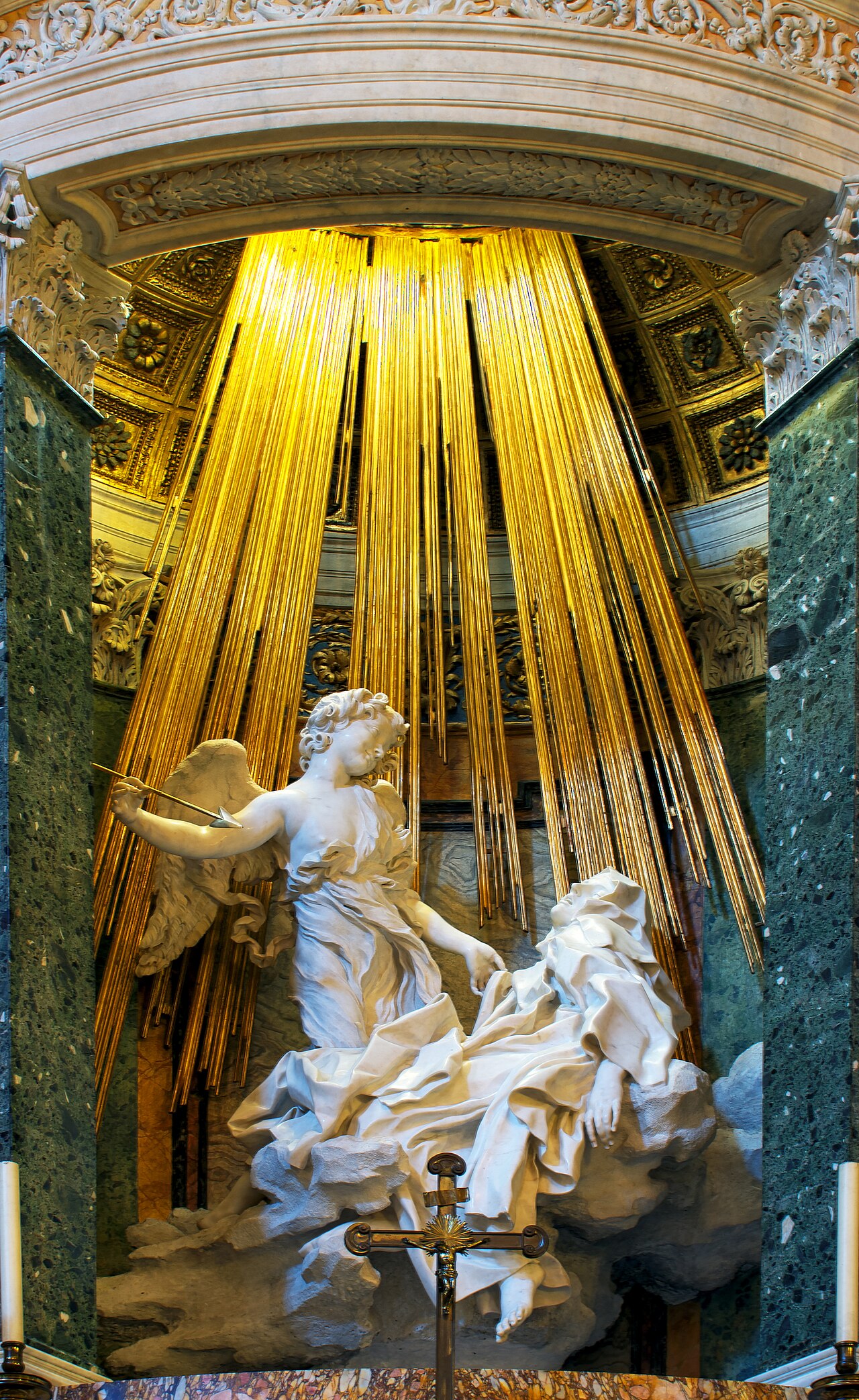
Her paternal grandfather was a converso condemned by the Spanish Inquisition for allegedly returning to Judaism. Her father, a wealthy wool merchant, bought a knighthood. Fascinated by saints' lives, she ran away at age seven seeking martyrdom. After her mother died when Teresa was fourteen, she deepened her devotion to the Virgin Mary. Her zeal for mortification caused severe illness, and she attributed her recovery to Saint Joseph. She began experiencing religious ecstasy and reported visions, including the transverberation, in which a seraph pierced her heart with a golden lance, causing both pain and sweetness. This episode inspired Bernini's Ecstasy of Saint Teresa.
Reader's Guide
Teresa of Ávila's significance lies in her role as a central figure of spiritual and monastic renewal during the Counter-Reformation. Her writings—The Life of Teresa of Jesus, The Interior Castle, and The Way of Perfection—are prominent works on Christian mysticism and meditation. In her autobiography, she discerned four stages of the soul's ascent to God. The Interior Castle uses the metaphor of seven mansions to describe states of the soul. Her detailed accounts of her religious experiences have also provided a rare 16th-century medical record, leading to speculative diagnoses such as temporal lobe epilepsy.
Did You Know?
- Her paternal grandfather was a converso condemned by the Spanish Inquisition for allegedly returning to Judaism.
- She ran away from home at age seven with her brother Rodrigo to seek martyrdom against the Moors.
- Her vision of a seraph piercing her heart with a golden lance inspired Bernini's Ecstasy of Saint Teresa.
Reforming the Carmelite Order
Teresa emerged as the driving force behind a sweeping spiritual and monastic renewal during the Counter-Reformation era. She reformed the Carmelite orders for both women and men, seeking to return them to a more rigorous, contemplative life. Her vision attracted the younger friar and mystic John of the Cross, who joined her movement and together they established the Discalced Carmelites. The split from the older order was formally recognized by a papal decree in 1580, cementing Teresa's reform as an independent branch within the broader Catholic Church. Her work was not merely institutional but deeply personal: she had entered the Carmelite Convent of the Incarnation in Ávila in 1534, a community she described as easy-going, and her own experience of its relaxed discipline fueled her desire for a more demanding spiritual path. The reform she championed became one of the defining religious movements of sixteenth-century Spain, reshaping monastic life well beyond the Iberian Peninsula.
Writings on the Soul's Ascent
Teresa's literary legacy stands as a cornerstone of Christian mystical thought. Her autobiography, The Life of Teresa of Jesus, was composed partly as a defense of her ecstatic experiences against accusations that they might be diabolical in origin. Within it, she maps four progressive stages of the soul's journey toward God: mental prayer and meditation, the prayer of quiet, absorption in God, and ecstatic consciousness. Her other major work, The Interior Castle, was written as a practical spiritual guide for her Carmelite sisters. There she employs the extended metaphor of seven mansions nested within the castle of the soul, each representing a distinct state the soul may inhabit throughout a lifetime. The Way of Perfection rounds out her published corpus. Together these texts shaped centuries of meditation practice and remain central references for anyone studying contemplative prayer within the Catholic tradition, bridging rigorous theology with vivid personal testimony.
A Childhood Forged by Faith and Loss
Teresa Sánchez de Cepeda Dávila y Ahumada was born on 28 March 1515, either in Ávila or the nearby village of Gotarrendura. Her family carried a complicated religious heritage: her paternal grandfather, Juan Sánchez de Toledo, had been a marrano—a Jew compelled to convert—and was later condemned by the Spanish Inquisition for allegedly reverting to Judaism before eventually re-establishing a Catholic identity. Her father, Alonso, was a prosperous wool merchant who purchased a knighthood and assimilated fully into Christian society. Teresa's mother, Beatriz, raised her in deep devotion. At just seven, Teresa and her brother Rodrigo attempted to flee home to seek martyrdom fighting the Moors, but an uncle intercepted them near the town walls. The death of her mother when Teresa was fourteen left her profoundly grief-stricken and led her to embrace the Virgin Mary as a spiritual mother. She attended the Augustinian nuns' school in Ávila and was drawn to the popular fiction of the period.
Ecstasy, Sainthood, and Enduring Legacy
Teresa's mystical life reached its most celebrated moment around 1559, when she reported that Christ appeared to her in bodily form, invisible yet present, in visions that lasted nearly two years. Among these was the famous transverberation: a seraph thrusting a golden lance tipped with fire repeatedly through her heart, leaving her, in her own words, 'all on fire with a great love of God,' the pain so immense it made her moan yet so sweet she could not wish it ended. Her confessor, the Jesuit Francis Borgia, had earlier reassured her that her experiences were divinely inspired. Augustine's Confessions, which she encountered during a period of scruple, also proved formative, showing her that even a great saint had once been a sinner. Forty years after her death in 1582, Pope Gregory XV canonized her in 1622. In 1970, Pope Paul VI proclaimed her the first woman ever named a Doctor of the Church, honoring her centuries-long spiritual influence.
Gallery
Frequently Asked Questions
Who is Teresa of Ávila?
She was a 16th-century Spanish Carmelite nun, mystic, and monastic reformer who became one of the most influential spiritual writers in the Western Christian tradition. Active during the Counter-Reformation, she is best known for her deep contemplative theology and her work renewing religious life.
What are Teresa of Ávila's most famous writings?
Her two landmark texts are The Interior Castle, which maps the soul's progressive journey toward union with God through seven stages, and The Way of Perfection, a practical guide for religious women. Both remain foundational works in Catholic spiritual theology.
What did Teresa of Ávila change in the Carmelite order?
She worked to restore the original, austere Carmelite rule that had grown lax, founding new communities for both nuns and friars. In close partnership with John of the Cross, she gave rise to the Discalced Carmelites, a reform branch that continues to this day.
More in Early Church Fathers And Saints 25-30
Elsewhere in the Early Church Fathers And Saints universe
Spotted an error? Know more?
This is a living reference — every entry is fact-audited, and reader corrections feed straight into our audit queue. Suggest an edit · See this site's audit record