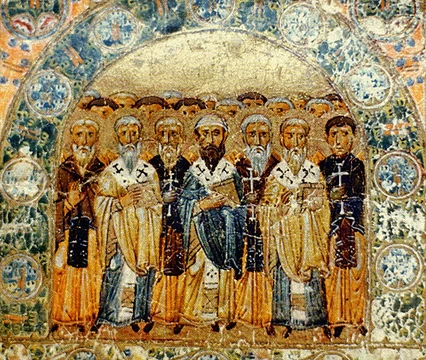
John of Damascus
Christian monk, theologian, and defender of holy images.

He is one of the Fathers of the Eastern Orthodox Church, best known for his strong defence of icons, and is regarded by the Catholic Church as a Doctor of the Church, often called the Doctor of the Assumption. A polymath whose fields included law, theology, philosophy, and music, he was given the by-name Chrysorroas ('the golden speaker'). His works expounding the Christian faith and his hymns are still used in Eastern Christian liturgy and in western Lutheranism at Easter.
- died
- Traditionally 4 December AD 749, at Mar Saba monastery near Jerusalem (precise date and place unknown)
- field
- Theology, philosophy, law, music, hymnography
- nationality
- Syrian Christian (Damascene)
- known_for
- Defence of icons, writings on the Assumption of Mary, concept of perichoresis, last of the Greek Fathers
Lore & Background
John was born in Damascus to a prominent Christian family. John was raised in Damascus; one account describes his tutor as a monk named Cosmas, kidnapped from Sicily, who taught him Hellenic and Latin scholarly traditions. In the early 8th century, iconoclasm gained acceptance in the Byzantine court. John of Damascus undertook a spirited defence of holy images in three separate publications, including his Apologetic Treatises against those Decrying the Holy Images. He attacked the Byzantine emperor and used a simplified style that stirred rebellion among iconoclasts. His writings later played an important role during the Second Council of Nicaea in 787. A hagiographical account reports that Leo III sent forged documents to the caliph implicating John in a plot, leading to John's right hand being cut off. After praying before an icon of the Theotokos, his hand was miraculously restored, and he attached a silver hand to the icon, which became known as the 'Three-handed' icon.
Reader's Guide
John of Damascus stands at the end of the Patristic period of dogmatic development, and his contributions are the last in the series of theological developments before the medieval period. In Catholic theology, he is known as the 'last of the Greek Fathers.' His most significant legacy is his strong defence of icons during the iconoclastic controversy, which helped shape Eastern Orthodox and Catholic teaching on the veneration of images. He also wrote on the Assumption of Mary, earning the title Doctor of the Assumption, and was a prominent exponent of perichoresis, using the term to describe the interpenetration of Christ's divine and human natures and the relationship between the hypostases of the Trinity. His hymns remain in liturgical use in Eastern Christianity and in western Lutheranism at Easter. The main biographical source is a hagiographical work attributed to John of Jerusalem, based on an earlier Arabic text, but it is prone to exaggeration and legendary details. The hagiographic novel Barlaam and Josaphat was later attributed to him, but most scholars no longer accept this.
Did You Know?
- John of Damascus was given the by-name Chrysorroas, meaning 'streaming with gold' or 'the golden speaker.'
- A hagiographical account claims that after his right hand was cut off, it was miraculously restored through prayer before an icon of the Theotokos.
- The main source for his life is a hagiographical work written by an unknown author between the early 9th and late 10th century.
Frequently Asked Questions
Why is John of Damascus called the last of the Greek Fathers?
He is traditionally viewed as the final major voice in the Greek-speaking patristic tradition before the era of the iconoclast controversy reshaped Eastern theology. His encyclopaedic works in theology, philosophy, law, and hymnography are seen as the capstone of that particular lineage of writers.
What is John of Damascus most famous for defending?
His most celebrated contribution is his vigorous theological defence of the veneration of holy icons against the iconoclast movement. He argued that honouring a painted image does not amount to worshipping the material object itself but directs reverence toward the person depicted.
What is the concept of perichoresis in John of Damascus's theology?
Perichoresis, as articulated by John of Damascus, describes the mutual indwelling and interpenetration of the divine persons within the Trinity. He employed this framework to explain how the three persons remain distinct yet are fully united in one divine essence.
How does John of Damascus's story end?
Tradition holds that he died on 4 December 749 at the Mar Saba monastery near Jerusalem, though the precise date and place remain uncertain. His feast day is commemorated on that date in both Eastern and Western liturgical calendars.
More in Early Church Fathers And Saints 1-24
Elsewhere in the Early Church Fathers And Saints universe
Spotted an error? Know more?
This is a living reference — every entry is fact-audited, and reader corrections feed straight into our audit queue. Suggest an edit · See this site's audit record