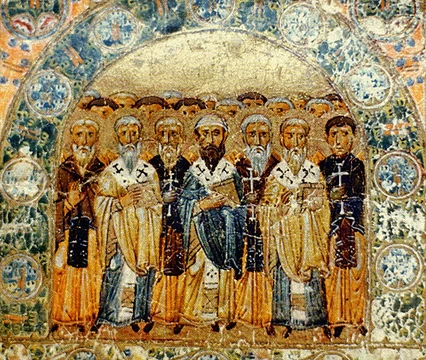
Denis of Paris
Decapitated bishop who walked miles preaching with his head in hand.

Denis of Paris (Latin: Dionysius) was a 3rd-century Christian martyr and saint. According to his hagiographies, he was bishop of Paris (then Lutetia) in the third century and, together with his companions Rusticus and Eleutherius, was martyred for his faith by decapitation. He is the most famous cephalophore in Christian history, with a popular story claiming that the decapitated bishop picked up his head and walked several miles while preaching a sermon on repentance. He is venerated in the Catholic Church as a patron saint of both France and Paris and is one of the Fourteen Holy Helpers.
- Born
- 3rd century (exact date unknown)
- Field
- Bishop, missionary, martyr
- Nationality
- Roman (sent from Italia to Gaul)
- Known for
- Cephalophore miracle; patron saint of France and Paris; one of the Fourteen Holy Helpers
Lore & Background
According to the earliest surviving account, the 'Passio SS. Dionysii Rustici et Eleutherii' (c. He was appointed first Bishop of Paris. The persecutions under Emperor Decius had all but dissolved the small Christian community at Lutetia. Denis, with his companions Rusticus and Eleutherius, settled on the Île de la Cité in the River Seine. Denis and his companions were so effective in converting people that pagan priests became alarmed. At their instigation, the Roman Governor arrested the missionaries. After a long imprisonment, Denis and two of his clergy were executed by beheading on the highest hill in Paris (now Montmartre), which was likely to have been a druidic holy place. The martyrdom is popularly believed to have given the site its current name, derived from the Latin Mons Martyrum 'The Martyrs' Mountain', although the name is possibly derived from Mons Mercurii et Mons Martis. After his head was cut off, Denis is said to have picked it up and walked several miles from the summit of the hill, preaching a sermon the entire way. The site where he stopped preaching and actually died was marked by a small shrine that developed into the Basilica of Saint-Denis, which became the burial place for the kings of France. Another account has his corpse being thrown into the Seine, but recovered and buried later that night by his converts.
Reader's Guide
Denis of Paris holds a central place in French Christian history as the city's first bishop and a martyr whose cult became intertwined with national identity. His veneration began soon after his death, with a shrine near the present basilica attested by the close of the fifth century. Dagobert I built the first Royal Basilica, and a successor church was erected by Fulrad, abbot from 749/50, linked with the accession of the Carolingians. Over time, Saint Denis came to be regarded as the patron saint of the French people, with the war-cry 'Montjoie! Saint Denis!' used by French armies. The oriflamme, the standard of France, was the banner consecrated upon his tomb. In traditional Catholic practice, Denis is honored as one of the Fourteen Holy Helpers, invoked against diabolical possession and headaches, and with Geneviève is one of the patron saints of Paris. Since at least the ninth century, his legends have been confused with those of Dionysius the Areopagite, an identification most historiographers agree is completely erroneous.
Did You Know?
- Denis is the most famous cephalophore in Christian history, said to have walked several miles after decapitation while preaching a sermon on repentance.
- The site of his martyrdom, Montmartre, derives its name from Latin Mons Martyrum 'The Martyrs' Mountain', though it may also come from Mons Mercurii et Mons Martis.
- The medieval and modern French masculine given name Denis derives from the Latin name Dionysius from Greek Dionysios.
Frequently Asked Questions
What is the famous 'walking head' legend about Denis of Paris?
His hagiographies tell that after Denis was beheaded, he gathered up his own severed head and walked several miles while preaching a sermon urging people to repent. This makes him the best-known cephalophore, or head-bearer, in all of Christian tradition.
Why is Denis of Paris considered important?
He is venerated in the Catholic Church as a patron saint of both France and the city of Paris, and he is included among the Fourteen Holy Helpers. His role as a pioneering missionary bishop who died for the faith in Gaul gave him a central place in Western Christian devotion.
Who were Denis of Paris's companions in his martyrdom?
Denis was executed alongside two companions, Rusticus and Eleutherius, who were also put to death by decapitation for their Christian belief. All three are commemorated together in the liturgical calendar and in the stories surrounding the martyrdom.
More in Early Church Fathers And Saints 1-24
Elsewhere in the Early Church Fathers And Saints universe
Spotted an error? Know more?
This is a living reference — every entry is fact-audited, and reader corrections feed straight into our audit queue. Suggest an edit · See this site's audit record