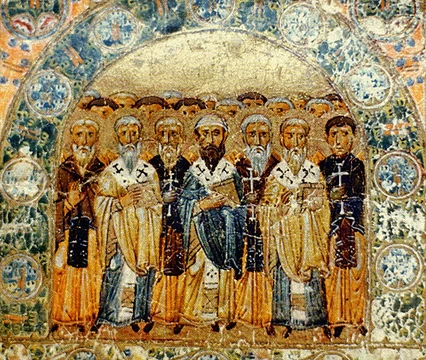
Justin Martyr
Early Christian apologist and philosopher, martyred in Rome.

Justin Martyr (c. 90–100 AD – 165 AD), also known as Justin the Philosopher, was an early Christian apologist and philosopher. His most well-known text, the First Apology, passionately defends the morality of the Christian life and provides arguments to convince the Roman emperor Antoninus Pius to abandon persecution of the Church. Justin also indicates that historical manifestations of the Logos predated Christ's incarnation, and that many historical Greek philosophers (including Socrates and Plato) were unknowing Christians. He was martyred, along with some of his students, during the reign of Marcus Aurelius around the year 165, and is venerated as a saint by the Catholic Church, the Eastern Orthodox Church, the Oriental Orthodox Churches, Lutheran Churches, and in Anglicanism.
- born
- c. 90–100 AD
- died
- c. 165 AD
- field
- Christian apologist, philosopher
- nationality
- Greek (from Flavia Neapolis, Samaria)
- known_for
- First Apology, Dialogue with Trypho, martyrdom
Lore & Background
Justin was born c. 90–100 AD into a Greek family at Flavia Neapolis (today Nablus) near the ancient biblical city of Shechem, in Samaria. He knew little or no Hebrew and Aramaic, and had only a passing acquaintance with Judaism. He was uncircumcised, and defined himself as a Gentile. His grandfather, Bacchius, had a Greek name, while his father, Priscus, bore a Latin name. In the opening of the Dialogue, Justin describes his early education, stating that his initial studies left him unsatisfied. He tried first the school of a Stoic philosopher, who was unable to explain God's being to him. He then attended a Peripatetic philosopher but was put off because the philosopher was too eager for his fee. Then he went to hear a Pythagorean philosopher who demanded that he first learn music, astronomy, and geometry, which he did not wish to do. Subsequently, he adopted Platonism after encountering a Platonist thinker who had recently settled in his city. Some time afterwards, he chanced upon an old man, possibly a Syrian Christian, in the vicinity of the seashore, who engaged him in a dialogue about God and spoke of the testimony of the prophets as being more reliable than the reasoning of philosophers. Moved by the aged man's argument, Justin renounced both his former religious faith and his philosophical background, choosing instead to rededicate his life to the service of the Divine. His newfound convictions were bolstered by the ascetic lives of the early Christians and the heroic example of the martyrs. As a result, he decided to travel throughout the land, spreading the knowledge of Christianity as the 'true philosophy.' His conversion is commonly assumed to have taken place at Ephesus though it may have occurred anywhere on the road from Syria Palestina to Rome. He then adopted the dress of a philosopher himself and traveled about teaching. During the reign of Antoninus Pius (138–161), he arrived in Rome and started his own school. Tatian was one of his pupils. In the reign of Marcus Aurelius, after disputing with the cynic philosopher Crescens, he was denounced by the latter to the authorities, according to Tatian (Address to the Greeks 19) and Eusebius (HE IV 16.7–8). Justin was tried, together with six friends (two of them, Euelpistus and Hierax, slaves educated by him), by the urban prefect Junius Rusticus, and was beheaded. Though the precise year of his death is uncertain, it can reasonably be dated by the prefectural term of Rusticus (who governed from 162 to 168). The Christian 'Martyrdom of Justin' reports a record of the trial. The Prefect Rusticus says: 'Approach and sacrifice, all of you, to the gods.' Justin says: 'No one in his right mind gives up piety for impiety.' The Prefect Rusticus says: 'If you do not obey, you will be tortured without mercy.' Justin replies: 'That is our desire, to be tortured for Our Lord, Jesus Christ, and so to be saved, for that will give us salvation and firm confidence at the more terrible universal tribunal of Our Lord and Saviour.' And all the martyrs said: 'Do as you wish; for we are Christians, and we do not sacrifice to idols.' The Prefect Rusticus read the sentence: 'Those who do not wish to sacrifice to the gods and to obey the emperor will be scourged and beheaded according to the laws.' The holy martyrs glorifying God betook themselves to the customary place, where they were beheaded and consummated their martyrdom confessing their Saviour.
Reader's Guide
Justin Martyr is significant as one of the earliest Christian apologists to engage systematically with Greek philosophy. His First Apology, addressed to Emperor Antoninus Pius, his sons, and the Roman Senate, is a key early defense of Christian morality and a plea to end persecution. The Dialogue with Trypho, a later work composed between 147 and 161, undertakes to show that Christianity is the new law for all men. Its central contention is that the Hebrew scriptures are the property of the Christians, because they alone grasp their true meaning – a comprehension that Jews, in Justin's view, lack entirely. Justin also wrote a Second Apology addressed to the Roman Senate, and other works including a treatise On the Sovereignty of God, a work entitled The Psalmist, a treatise in scholastic form On the Soul, and an apology 'Against Marcion' known from Irenaeus. His writings, preserved in a single 14th-century codex (Parisinus graecus 450) completed on 11 September 1364 somewhere in the Byzantine Empire, influenced later Church Fathers such as Irenaeus (who quotes Justin twice and shows his influence in other places), Tertullian (who calls Justin a philosopher and a martyr and the earliest antagonist of heretics), Hippolytus, Methodius of Olympus, and Eusebius of Caesarea. The editio princeps was published by Robert Estienne in 1551. Justin's legacy endures as a bridge between classical philosophy and Christian theology, and he is venerated as a saint in multiple traditions.
Did You Know?
- Justin was uncircumcised and defined himself as a Gentile, with little knowledge of Hebrew or Aramaic.
- His grandfather Bacchius had a Greek name, while his father Priscus bore a Latin name.
- Justin tried Stoic, Peripatetic, and Pythagorean schools before adopting Platonism, and was finally converted by an old man (possibly a Syrian Christian) he met near the seashore.
- He was tried and beheaded along with six friends, including two slaves named Euelpistus and Hierax, by the urban prefect Junius Rusticus.
- All of Justin's authentic works survive in a single 14th-century codex, Parisinus graecus 450, completed on 11 September 1364.
Frequently Asked Questions
Who is Justin Martyr?
Justin Martyr, also called Justin the Philosopher, was a Greek Christian apologist and philosopher born around 90–100 AD in Flavia Neapolis, Samaria. He is one of the most prominent early defenders of the Christian faith outside the apostolic generation.
What are Justin Martyr's major works?
His two best-known texts are the First Apology, which argues that Christian ethics are sound and calls for an end to state persecution, and the Dialogue with Trypho, a lengthy conversation with a Jewish interlocutor. Together these works anchor his reputation as a bridge between Greek philosophy and Christian theology.
How does Justin Martyr's story end?
He was executed as a martyr in Rome around 165 AD, making him one of the earliest recorded Christian martyrs to die in the imperial capital. His death cemented his title 'the Martyr' in the tradition.
Why is Justin Martyr important to early Christianity?
He is venerated as a saint across several Christian denominations and is regarded as the first major Christian thinker to systematically use Greek philosophical language to explain the faith to a pagan audience. His apologetic method set a template that later Church Fathers would follow.
Where was Justin Martyr from?
He was born in Flavia Neapolis, in the region of Samaria, and is identified as Greek by nationality. This background gave him direct access to the philosophical schools of the eastern Mediterranean, which shaped his approach to defending Christianity.
More in Early Church Fathers And Saints 1-24
Elsewhere in the Early Church Fathers And Saints universe
Spotted an error? Know more?
This is a living reference — every entry is fact-audited, and reader corrections feed straight into our audit queue. Suggest an edit · See this site's audit record