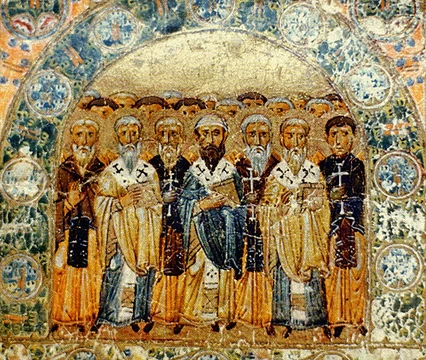
John Chrysostom
Church Father and Archbishop of Constantinople known for eloquent preaching.

John Chrysostom (c. 347 – 14 September 407) was a Church Father who served as Archbishop of Constantinople. He is known for his preaching and public speaking, particularly on the poor, his Divine Liturgy of Saint John Chrysostom, and his ascetic sensibilities. He is honored as a saint in the Catholic and Eastern churches, and is regarded by the Eastern Orthodox and Byzantine Catholics as one of the Three Holy Hierarchs (alongside Basil of Caesarea and Gregory of Nazianzus), and by the Catholic Church as one of the four Great Greek Church Fathers (alongside Athanasius of Alexandria).
- born
- c. 347, Antioch, Roman Syria (modern-day Antakya, Hatay, Turkey)
- died
- 14 September 407
- field
- Church Father, Archbishop of Constantinople
- nationality
- Roman (Syrian-born)
- known_for
- Preaching on the poor, Divine Liturgy of Saint John Chrysostom, asceticism, Thre
Lore & Background
John was born in Antioch, Roman Syria (modern-day Antakya, Hatay, Turkey) in 347. His father, a high-ranking military officer, died soon after his birth, and he was raised by his mother Anthusa, whom Christian tradition describes as a devout Christian. He was baptized in 368 or 373 and tonsured as a reader. He studied rhetoric under Libanius in the Sophist school, eventually becoming a lawyer, then studied theology under Diodorus of Tarsus. Around 375 he became a hermit, spending two years continually standing, scarcely sleeping, and committing the Bible to memory, which permanently damaged his stomach and kidneys. He was ordained a deacon in 381 by Meletius of Antioch and a presbyter in 388 by Evagrius of Antioch. For twelve years (386–397) in Antioch, he gained popularity for his eloquent public speaking at the Golden Church, emphasizing charitable giving and speaking against abuse of wealth. During Lent in 387, after citizens mutilated statues of Emperor Theodosius I, John preached more than twenty homilies entreating the people to see their error, leading many pagans to convert and sparing the city from severe consequences.
Reader's Guide
John Chrysostom's significance lies in his enduring influence as a preacher and theologian. His homilies, known for their straightforward, practical interpretation of Scripture, shaped Christian moral teaching, especially on wealth and poverty. His Divine Liturgy of Saint John Chrysostom remains central to Eastern Christian worship. His conflicts with imperial and ecclesiastical authorities highlight tensions between church and state in the late Roman Empire. Appointed Archbishop of Constantinople in autumn 397, he refused lavish social gatherings, making him popular with common people but unpopular with wealthy citizens and clergy. He founded hospitals in Constantinople. His denunciations of extravagance in feminine dress angered Empress Aelia Eudoxia, and his connection to Origen was used against him at the Synod of the Oak in 403, resulting in his deposition and banishment. He was recalled after an earthquake, but after denouncing the dedication of a silver statue of Eudoxia as pagan, he was banished again, this time to the Caucasus in Abkhazia. Around 405, he lent moral and financial support to Christian monks destroying pagan temples in Phoenicia. He died at Comana Pontica on 14 September 407 while being further exiled to Pitiunt.
Did You Know?
- John was sometimes said to have been bitten by a snake when he was ten years old, resulting in infection from the bite.
- Libanius, John's rhetoric teacher, was supposed to have said on his deathbed that John would have been his successor 'if the Christians had not taken him from us.'
- John's two years as a hermit involved continually standing, scarcely sleeping, and committing the Bible to memory, which permanently damaged his stomach and kidneys.
- During Lent in 387, John preached more than twenty homilies after citizens mutilated statues of Emperor Theodosius I, helping to calm the riot and leading many pagans to convert.
- John was appointed Archbishop of Constantinople in autumn 397 without his knowledge by the eunuch Eutropius, and had to leave Antioch in secret to avoid civil unrest.
Frequently Asked Questions
Who is John Chrysostom?
John Chrysostom was a Syrian-born Roman who rose to become Archbishop of Constantinople in the late fourth century. His name, meaning 'Golden Mouth,' reflects the reputation he built as one of the most striking orators the early Church ever produced.
What is John Chrysostom most famous for?
He is best remembered for his fiery sermons pressing the wealthy to feed the poor, his rigorous personal asceticism, and the Eucharistic rite still called the Divine Liturgy of Saint John Chrysostom. His homiletic corpus remains a foundational reference for Christian preaching.
How did John Chrysostom's story end?
After a bitter conflict with the imperial court led to his deposition, he was sent into exile and died on 14 September 407 while traveling to a further place of banishment. According to tradition, the faithful in Constantinople shouted 'Chrysostom has conquered' upon learning of his death.
Why is John Chrysostom important in Christian history?
He is honored as a saint in both the Catholic and Eastern churches, counted among the four Great Greek Fathers in the West and one of the Three Holy Hierarchs in the East. His liturgical and homiletic legacy continues to shape how Orthodox and Byzantine Catholic communities worship and preach.
What is the Divine Liturgy of Saint John Chrysostom?
It is the principal form of the Eucharistic celebration in the Eastern Orthodox and Byzantine Catholic traditions, organized around his theological and pastoral vision. The rite centers on the anaphora, the real presence of Christ in the Eucharist, and the full participation of the assembled faithful.
More in Early Church Fathers And Saints 1-24
Related in Early Church Fathers And Saints
Links follow this subject's own source article.
Elsewhere in the Early Church Fathers And Saints universe
Spotted an error? Know more?
This is a living reference — every entry is fact-audited, and reader corrections feed straight into our audit queue. Suggest an edit · See this site's audit record